Recommendations from Serbia





 0 ℃

Knez Miloš
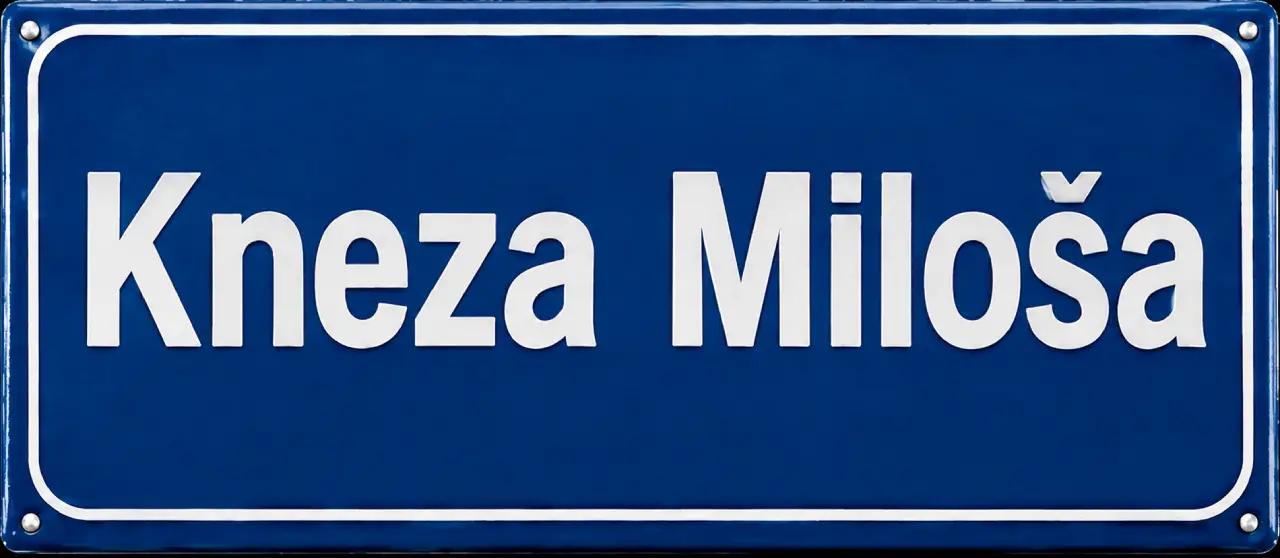
Knez Miloš Street – The History of One of Belgrade’s Most Important Streets
Knez Miloš Street is one of the most famous and historically significant thoroughfares in Belgrade. It stretches through the central part of the city, connecting the area around Savski Trg and Nemanjina Street with the broader urban area towards Slavija and King Alexander Boulevard. Its history traces the development of Belgrade from a small oriental town into a modern European capital. Along this street, state institutions, military buildings, representative edifices, and important municipal institutions emerged, over time making it one of the symbols of Serbia's political and administrative life.
It was named after Prince Miloš Obrenović, the ruler who played a decisive role in the creation of the modern Serbian state and the shaping of Belgrade during the 19th century. However, the significance of this street lies not only in the personality to whom it is dedicated. Its route, architecture, and surrounding buildings bear witness to how the capital changed through different historical periods.
From the Topčider Road to an Important City Thoroughfare
Knez Miloš Street originated in an area that once served as one of the exit routes from the Belgrade of that era towards Topčider. In the first half of the 19th century, this part of the city did not look as we know it today. Belgrade still bore strong characteristics of the Ottoman period, while its urban development gradually shifted towards European models.
Prince Miloš Obrenović had a clear vision that Belgrade should become the modern political and administrative center of the renewed Serbian state. Within his plans for city development, special attention was paid to the area towards Vračar and Topčider. Engineer Franz Janke was engaged for urban planning and drafted a regulation plan for this part of the city. His concept involved a more regular street network, block construction, and the formation of a representative urban space.
The Topčider Road gradually grew into an arranged city street. State and public buildings began to be built around it, and the area that was previously on the outskirts of the town of that time became an important part of its expansion.
In the history of Belgrade, the street is also recorded as one of the thoroughfares whose direction has been preserved through a long period of city development. Its role changed not only due to traffic, but also because of the contents and activities that developed along it.
Why Is It Named After Prince Miloš Obrenović?
Prince Miloš Obrenović (1780–1860) was one of the most important figures in 19th-century Serbian history. As the leader of the Second Serbian Uprising in 1815, he laid the foundations for Serbia's autonomy within the Ottoman Empire. His political activity contributed to the gradual strengthening of Serbian statehood, the development of institutions, and the creation of conditions for the later achievement of independence.
During his reign, he strove to give Belgrade the appearance and functions suited to the capital of a modern state. He encouraged the construction of state facilities, street improvements, and the development of the area meant to become the new administrative center. For this reason, his name is associated with numerous places and buildings in Belgrade.
The street that bears his name today serves as a kind of reminder of the period when the Serbian state began to shape its own political and urban identity. Its name is also part of the city's broader historical heritage, in which many significant streets were named after rulers, statesmen, military commanders, and other figures who marked national history.
A Street of State Institutions and Representative Edifices
During the second half of the 19th century, Knez Miloš Street assumed an increasingly pronounced administrative and representative role. The idea of forming a center of state power in this part of the city was gradually realized through the construction of important public facilities.
One of the significant historical spaces in its vicinity is the former Court Complex of Prince Miloš, specifically his residence (konak) in today's Gavrilo Princip Park. In the wider surroundings, military and state buildings were erected, and at the end of the 19th century, the Church of the Ascension of the Lord was built, becoming an important spiritual and architectural focal point of this part of the city.
As Belgrade grew, the street acquired more and more buildings intended for the work of state bodies, ministries, and other institutions. Its architecture reflected changes in society: from 19th-century buildings, through representative structures of the interwar period, to monumental edifices created in the second half of the 20th century.
Thus, Knez Miloš Street became a space where different architectural styles and urban planning ideas can be traced. Its uniqueness lies precisely in the blend of historical buildings and structures that testify to Serbia's more recent past.
Development Through the 20th Century
At the beginning of the 20th century, Belgrade developed rapidly, and Knez Miloš Street maintained its important position in the city's structure. In the period between the two World Wars, the expansion of state and administrative contents continued, while new buildings changed the appearance of certain parts of the street.
Following World War II, with the change in the state system, the character of the institutions located in this part of the city also changed. The street became one of the most important administrative axes of the former Yugoslavia, lined with the buildings of ministries, state bodies, and diplomatic missions.
A special place in its recent history is held by the 1999 NATO bombing of Belgrade. Some of the buildings in Knez Miloš Street were heavily damaged at that time, and several remained as visible scars of that period. Their fate still serves as a reminder of the events that marked the end of the 20th century and left a deep trace on the city's history.
Knez Miloš Street Today
Today, Knez Miloš Street is one of the most important city thoroughfares and administrative zones in Belgrade. Its surroundings feature numerous state institutions, embassies, office buildings, hotels, restaurants, and other amenities that give this part of the city a dynamic character.
Although heavily burdened by traffic, its significance extends far beyond the daily movement of people and vehicles. It represents an important connection between different parts of central Belgrade, as well as a space where various epochs of the Serbian capital's development can be recognized.
Knez Miloš Street is not just another major city avenue. Its history speaks of the emergence of the modern Serbian state, the urban transformation of Belgrade, and the development of institutions that shaped its political and social life. From a former Topčider road to today's representative city street, it has remained one of the most vital witnesses to Belgrade's history.